

Writing Blog Posts for SEO: 2025 Tips for Canadian DIYers

Writing blog posts for SEO used to feel like a guessing game for most Canadian DIYers. The internet is flooded with content but only a tiny fraction ever gets noticed, with less than 1 percent of Google searchers clicking past the first page . That sounds discouraging, right? Most bloggers focus on new topics and flashy growth hacks but they miss the real difference simple tweaks and regular updates can make. If you want your blog posts to pull real traffic in 2025 it starts with smarter choices that most people overlook.
Table of Contents
- Choosing The Right Seo Blog Topics
- Crafting Seo-Friendly Headlines And Structure
- Optimizing Content For Google And Local Search
- Measuring Success And Updating Blog Posts
Quick Summary
Choosing the Right SEO Blog Topics
Selecting the right blog topics is a critical foundation for successful writing blog posts for SEO. Your content strategy determines whether you’ll attract engaged readers or get lost in the digital noise. Smart topic selection requires a strategic approach that combines audience insights, search demand, and your unique expertise.
Understanding Keyword Research Fundamentals
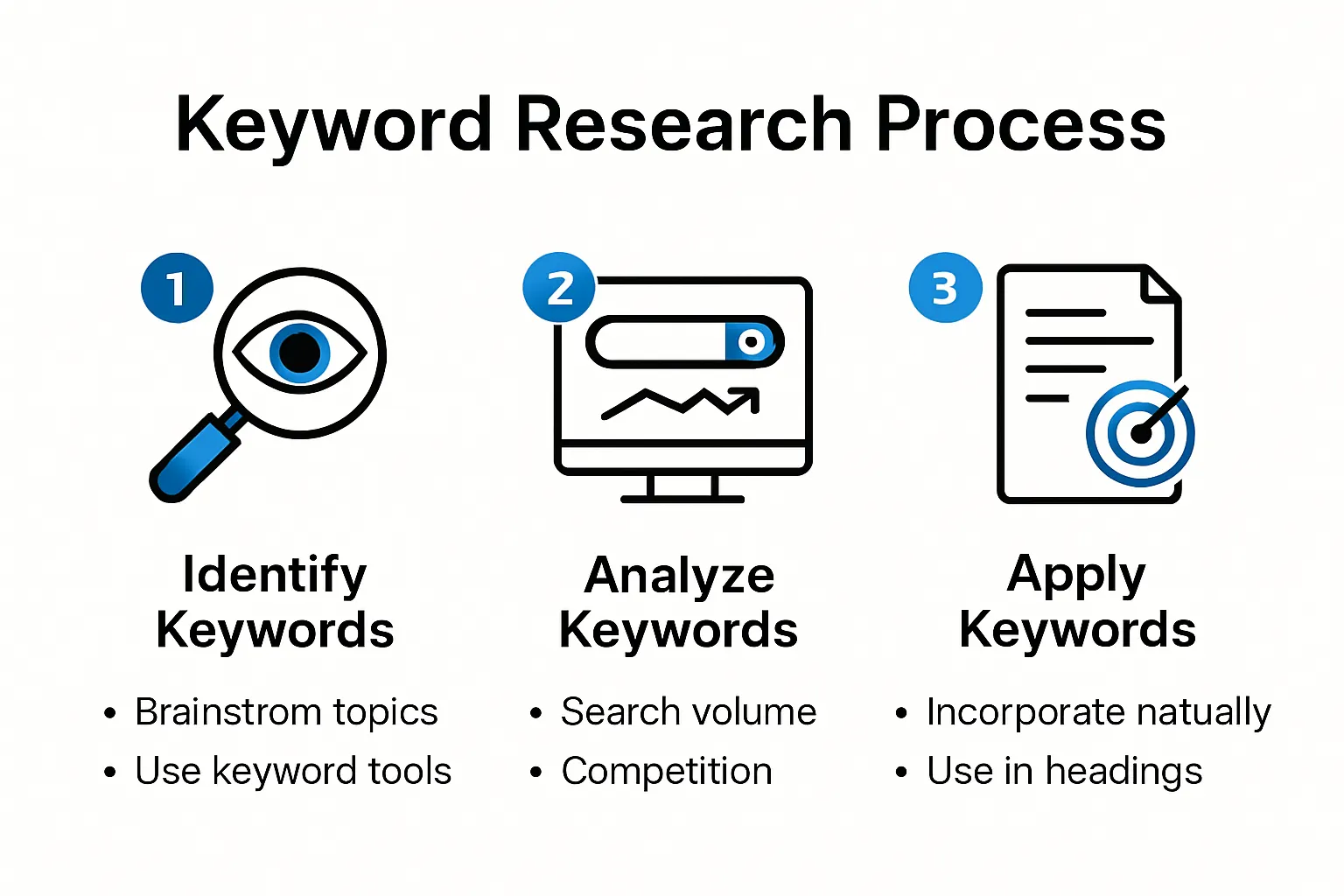
Keyword research is the compass that guides your content creation journey. Carnegie Higher Ed Marketing recommends utilizing free keyword research tools like Google Search Console and Google Keyword Planner to identify terms your target audience actively searches for.
Start by brainstorming topics relevant to your niche. Consider questions your potential readers might ask. What problems do they need solutions for? What information would provide genuine value? These questions help you uncover topic ideas that resonate with your audience and align with search intent.
Look for keywords with reasonable search volume but not extreme competition. Long tail keywords often represent excellent opportunities for writing blog posts for SEO. These more specific phrases might have lower search volumes but typically indicate higher user intent and less competitive ranking landscapes.
Aligning Topics with User Intent
The University of Louisiana at Lafayette emphasizes the importance of systematic keyword assignment and content planning. This means each blog topic should serve a clear purpose:
- Informational Intent : Blog posts that answer specific questions or provide comprehensive guides
- Navigational Intent : Content helping readers find specific resources or solutions
- Transactional Intent : Posts that guide readers toward making a decision or taking action
Each blog topic should map directly to one of these intents. This strategic alignment ensures your content meets reader expectations and signals relevance to search engines.
To further clarify how blog topics can be aligned with different user intents, the table below summarizes the characteristics and content strategies for each type of intent discussed above.
Creating a Sustainable Content Strategy
EDUCAUSE Review advises maintaining a professional online presence through consistent, high-quality content updates. Develop a content calendar that balances evergreen topics with current trends in your industry.
Consider creating topic clusters where one main pillar page covers a broad subject, with supporting blog posts diving deeper into specific subtopics. This approach not only provides comprehensive information but also helps search engines understand the depth and relevance of your content.
Remember, successful writing blog posts for SEO isn’t about churning out content rapidly. It’s about crafting meaningful, well-researched pieces that genuinely help your audience solve problems or gain insights. Quality trumps quantity every time.
By implementing these strategic topic selection methods, you’ll create a robust content foundation that attracts readers, satisfies search intent, and positions you as a trusted resource in your niche.
Crafting SEO-Friendly Headlines and Structure
Crafting compelling headlines and structuring content for search engine optimization is an art that combines creativity with strategic thinking. Your headline and content structure are the first elements that determine whether readers will engage with your blog post and how search engines will interpret its relevance.
The Science of Headline Writing
The University of Oxford recommends creating headlines that are specific, keyword-rich, and compelling. Aim for headlines between 6-12 words that use active voice and strong verbs. These headlines not only attract readers but also signal to search engines the core topic of your content.
When writing headlines for SEO, consider these critical elements:
- Clarity : Ensure the headline directly communicates the content’s value
- Keyword Placement : Include your primary keyword naturally near the beginning of the headline
- Emotional Trigger : Use words that evoke curiosity or solve a specific problem
Avoid clickbait tactics. Your headline should accurately represent the content’s substance. Search engines are sophisticated enough to recognize and potentially penalize misleading headlines that don’t match the actual content.
Structuring Content for Maximum SEO Impact
The University of Louisiana at Lafayette emphasizes the importance of strategic keyword integration throughout your content structure. Your blog post should be a well-organized piece that guides readers logically while providing clear signals to search engines.
Implement these structural strategies:
- Use header tags (H1, H2, H3) hierarchically
- Break content into digestible paragraphs
- Include relevant keywords in headers and first paragraphs
- Create clear, scannable sections that answer specific reader questions
Consider the user experience alongside SEO requirements. A well-structured post should feel natural and engaging, not artificially stuffed with keywords. Each section should flow logically and provide genuine value to the reader.

Technical Optimization Techniques
Beyond visual structure, technical elements play a crucial role in SEO performance. Optimize your blog post with these technical considerations:
- Ensure mobile responsiveness
- Use descriptive image alt texts
- Create internal links to related content
- Implement schema markup where appropriate
- Maintain a reasonable content length (typically 1000-2500 words)
Remember that writing blog posts for SEO is about balance. Your content must satisfy both human readers and search engine algorithms. This means creating genuinely helpful, well-researched content that answers specific user queries while following technical SEO best practices.
By mastering headline creation and content structure, you transform your blog posts from mere text into strategic communication tools that attract, engage, and convert readers while improving your search engine rankings.
Optimizing Content for Google and Local Search
Optimizing content for Google and local search requires a nuanced approach that goes beyond basic keyword placement. Your strategy must blend technical precision with genuine, location-specific value that speaks directly to your Canadian audience.
Local Keyword Integration Strategies
The University of Maryland Libraries emphasizes creating compelling and useful content that genuinely serves your readers. For local search optimization, this means weaving location-specific keywords naturally into your content.
Focus on integrating location-based terms that reflect how local Canadian audiences search. Instead of generic phrases, use specific regional identifiers. For example, rather than just “SEO services,” use “SEO services in Manitoba” or “Toronto digital marketing strategies.” These hyper-local keywords signal to search engines your relevance to specific geographic markets.
Consider these local keyword optimization techniques:
- Neighborhood References : Mention specific neighbourhoods or cities
- Regional Language : Use terms specific to Canadian English
- Local Event or Cultural References : Connect content to local contexts
For quick reference, the table below summarizes the distinct local keyword strategies mentioned, with brief explanations and examples geared to Canadian audiences.
Technical Optimization for Search Performance
Grand Valley State University highlights the critical role of mobile optimization and location-based search results. Your content must be technically sound and geographically targeted.
Ensure your website and blog posts are fully responsive across devices. Google prioritizes mobile-friendly content, so your design must adapt seamlessly to smartphones, tablets, and desktop computers. This technical foundation is crucial for local search rankings.
Implement structured data markup that helps search engines understand your local context. Include:
- Business address
- Service areas
- Local contact information
- Geographic service descriptions
Creating Locally Relevant Content
The University of Illinois Extension recommends creating content that speaks directly to local audience needs. Your blog posts should solve specific problems or answer questions relevant to Canadian businesses and consumers.
Develop content that demonstrates deep understanding of local market dynamics. This might include:
- Analyzing regional business trends
- Discussing local economic challenges
- Providing solutions tailored to Canadian market specifics
- Addressing region-specific regulatory or industry considerations
Remember that writing blog posts for SEO isn’t just about ranking. It’s about creating genuine value for your local audience. Each piece of content should feel like it was crafted specifically for your Canadian readers, with insights and perspectives that resonate with their unique experiences.
By combining strategic keyword usage, technical optimization, and locally relevant content, you’ll create a powerful SEO approach that attracts both search engines and your target Canadian audience. Your content becomes a bridge connecting local businesses with potential customers, powered by intelligent, location-specific digital strategies.
Measuring Success and Updating Blog Posts
Measuring the performance of your blog posts and strategically updating content is crucial for maintaining a robust SEO strategy. Without proper tracking and refinement, even the most well-crafted content can become stale and lose its search engine ranking potential.
Essential SEO Performance Metrics
The Digital Marketing Institute emphasizes tracking comprehensive performance metrics to understand your content’s effectiveness. Key indicators include:
- Conversion Rate : Percentage of readers taking desired actions
- Time on Site : Average duration visitors spend reading your content
- Inlinks : Number of internal and external links pointing to the post
- Audience Demographics : Understanding who engages with your content
Utilize tools like Google Analytics, SEMrush, and Raven to gather these insights. These platforms provide detailed analytics that help you understand how your blog posts perform in the competitive digital landscape.
Strategic Content Updating Techniques
SubHub recommends a systematic approach to refreshing blog content. Start by identifying your top-performing posts using Google Search Console. Look for articles with consistent traffic but potential for improvement.
When updating blog posts, focus on:
- Adding recent statistics and current research
- Updating outdated information
- Improving readability and formatting
- Enhancing keyword optimization
- Ensuring mobile responsiveness
After making updates, submit the revised post to Google Search Console for reindexing. This signals to search engines that your content has been refreshed and remains relevant.
Long-Term Content Maintenance Strategy
SEMrush highlights the necessity of continuous content refinement. Blog posts can lose their search ranking over time as information becomes outdated and search algorithms evolve.
Develop a content maintenance schedule:
- Review blog posts quarterly
- Check for accuracy of information
- Update keywords to match current search trends
- Align content with current user search intent
- Remove or replace broken links
Consider creating a content calendar specifically for updating existing blog posts. This proactive approach ensures your content remains fresh, authoritative, and competitive in search rankings.
Remember that writing blog posts for SEO is an ongoing process. Your content should be a living resource that adapts to changes in your industry, audience needs, and search engine algorithms.
By implementing these measurement and updating strategies, you transform your blog from a static collection of articles into a dynamic, high-performing SEO asset that continually attracts and engages your target audience.
Frequently Asked Questions
What are the best practices for keyword research in SEO?
Keyword research should start with brainstorming relevant topics and questions your audience may have. Use tools like Google Keyword Planner to find keywords with decent search volume and lower competition, focusing on long-tail keywords for specific user intent.
How can I align my blog topics with user intent?
To align topics with user intent, categorize them into informational, navigational, or transactional intents. Each blog post should serve a clear purpose, answering questions, helping users find resources, or guiding them towards decisions or actions.
What strategies improve local SEO for Canadian audiences?
To improve local SEO, integrate location-specific keywords into your content. Mention local neighbourhoods, use Canadian English terms, and connect your content to local events and cultural references. This signals relevance to search engines and attracts local readers.
How often should I update my blog content for SEO?
Regular content updates should ideally be done every few months. Review and refresh your blog posts to include the latest information, optimize keywords, and improve readability. This keeps your content relevant and helps maintain or improve search rankings.
Struggling to Get Your SEO Blog Posts Noticed in Canada?
You have worked hard learning about keyword research, headlines, and local SEO strategies. But even after applying the best tips from Writing Blog Posts for SEO: 2025 Tips for Canadian DIYers, your posts are not bringing in enough local readers. It is frustrating when you spend hours creating content that still ends up hidden beyond Google’s first page. The article points out how tough it is for Canadian DIYers to choose winning topics and keep blogs updated so they stay visible and drive results. If you feel left behind because the competition is getting all the clicks in your area, you are not alone.
Imagine seeing your blog rank in the top 3 spots for Canadian searches. With Freedom SEO, this goal is within reach.
Ready to go beyond the basics and land your business in front of more local clients? Our Local SEO Services in Canada are designed for Canadians just like you who want guaranteed results fast. We focus on ranking your blog, Google Business Profile, and entire website where it matters most. Let us put your hard work into action so your DIY guides and solutions reach the audience you deserve. Start with a free consultation on our landing page . Your first step toward lasting growth and visibility is just one click away.